

NANO.IL 2027 - ICS 90th Tutorials Day
February 11, 2027
Join Our NANO.IL 2027 - ICS 90th Tutorials Day which offers 10 Tutorials in Various Fields of Nanotechnology.
The Tutorials Day is open to all conference participants, as well as to those not attending the main conference.
To download the PDF tutorials program click here
The Tutorials will be held on the Edmond J. Safra Campus (Givat Ram), The Hebrew University of Jerusalem, Israel.
The purpose of the tutorials is to provide knowledge, especially for engineers, and also for those who do not come from the field but are interested in learning more about it and harnessing their skills in the nanotechnology field, each in their own domain.
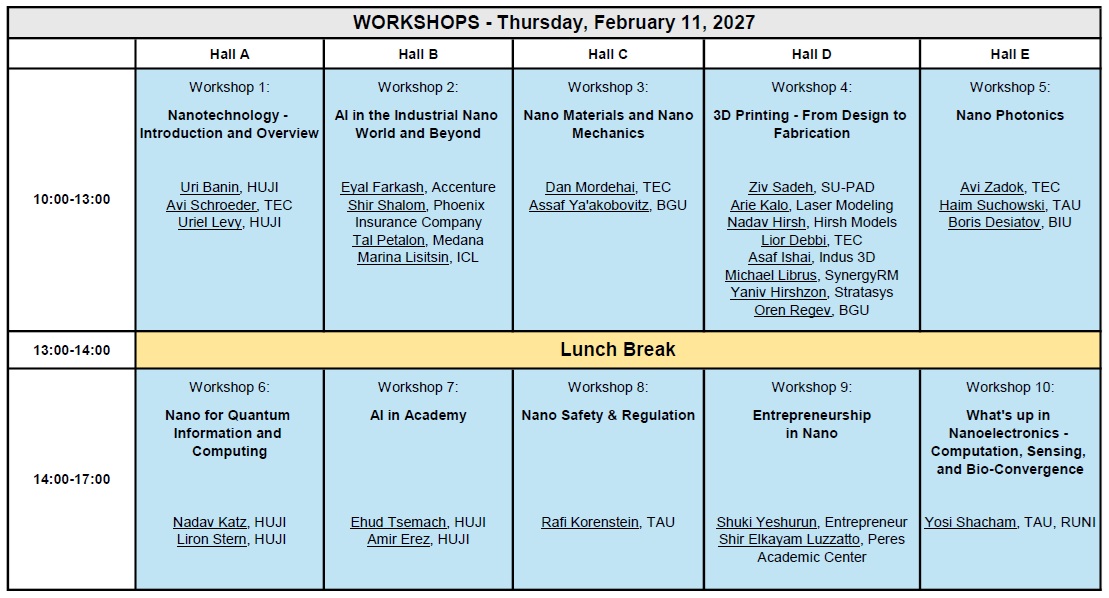
The following tutorials will be delivered by the leaders in the fields. The duration of each tutorial shall be three hours. There will be a morning session, lunch break and afternoon session of tutorials.
Tutorial Topics
Workshop 1 - Nanotechnology - Introduction and Overview
Prof. Uri Banin (moderator, the Hebrew University of Jerusalem)
Prof. Avi Schroeder (Technion – Israel Institute of Technology)
Prof. Uriel Levy (the Hebrew University of Jerusalem)
The tutorial will feature three speakers that will introduce the basic concepts of nanotechnology and its promise in diverse fields of research and applications (see below for specific titles). Following a presentation on the perspectives and fascinating properties of materials and devices that emerge in the nanoscale, a discussion on the attributes and technologies derived from new Nanomaterials, ranging from new display technologies to novel photocatalytic materials for solar fuels generation and 3D printing, will be discussed. This will be followed by a presentation on what the present and future hold in the area of Nanomedicine. The tutorial will be concluded by a presentation on how to control and utilize light on the nanoscale and the technological future of Nanophotonics in diverse areas including electrooptics, cameras, sensing and optical computing.
The three talks in the tutorial:
- “Small is different: Nanomaterials from science to applications”, Uri Banin, the Hebrew University of Jerusalem
- “Nanotechnology in the future of medicine: Principles for targeting therapeutic nanotechnologies to the brain”
Avi Schroeder, Technion – Israel Institute of Technology - “Nanophotonics: Science and applications”, Uriel Levy, the Hebrew University of Jerusalem
Workshop 2 - AI in the Industrial Nano World and Beyond
Eyal Farkash, Accenture Israel
Artificial Intelligence
This 3-hour workshop focuses on the fundamentals of Artificial Intelligence and its practical applications in today’s industry.
The workshop opens with an introductory session by Eyal Farkash, presenting AI as a tool—from core concepts and current industrial use to emerging trends.
The workshop continues with a series of short TED-style talks:
Shir Shalom, CPA, from The Phoenix Insurance Company, will address risk management in the use of generative AI and organizational preparedness.
Dr. Tal Petalon, Founder and CEO of Medana, will present AI applications in public health and personalized medicine.
Dr. Marina Lisitsin, AI Research Lead at ICL, will share real-world AI use cases in chemistry, agriculture, and environmental domains.
The workshop is intended for participants with a moderate background in AI and offers a multidisciplinary perspective on the role of artificial intelligence in advanced research and high-tech industries.
Workshop 3 - Nano Materials and Nano Mechanics
Dan Mordehai, Faculty of Mechanical Engineering, Technion, Israel
Assaf Ya’akobovitz, Department of Mechanical Engineering, Faculty of Engineering Sciences, Ben-Gurion University of the Negev, Israel
Nanomaterials are specimens in which at least one of their dimensions is reduced to the nanometer scale. The reduction in the dimensions leads to different material properties than the bulk counterparts. In this tutorial, we discuss different types of nanomaterials, with nanometer scale size in one, two or three dimensions, and we shall focus how the small dimensions results in unique mechanical properties at the nanoscale.
In the first part, we will review the main groups of 2D materials, which are a class of material with a size of a few atomic layers in one dimensions. We will discuss common means to realize thin 2D materials (e.g., exfoliation and growth). We will present applications of these materials from which we will emphasize the importance of understanding their mechanical properties. Then we will discuss methods for studying the mechanics of 2D materials, including the indentation method, the buckling method, the bulge method (pressurized cell method), the resonance method, and so on.
In the second part, we will present specimens with nanometer scales in two or three dimensions, such as nanowires and nanoparticles. We will discuss their fabrication methods and how their mechanical properties are measured. The large surface-to-volume ratios leads to unique size- and shape-effects in elasticity and plasticity. We will discuss the microstructural origins and how the indentation method is used to study size effects. In addition, we will present computational methods, such as molecular dynamics and dislocation dynamics simulation, to study nanomechanics. Finally, we will elaborate on how the unique mechanical properties at the nanoscale makes these materials good candidates as building block for various applications.
Workshop 4 - 3D Printing - From Design to Fabrication
Ziv Sadeh, SU-PAD
Arie Kalo, Laser Modeling
Nadav Hirsh, Hirsh Models
Lior Debbi, Technion
Asaf Ishai, Indus 3D
Michael Librus, SynergyRM
Yaniv Hirshzon, Stratasys
Oren Regev, Ben Gurion University of the Negev
Additive Manufacturing Nexus Tutorial
3D Printing known today as additive manufacturing is already a widely used technology. Never the less most users are familiar with several technologies and materials. The aim of this Nexus Session is to cover widely the 5 Polymer Printing Methods and to cover the innovation, applications and unique points of each technology. The speakers of each technology are experienced users.
For the Nano Part of the session we will host distinguished academy leaders who will cover both for nano specific technologies and application.
Agenda:
- 09:30-10:00 Reception
- 10:00-10:05 AM Industry Trend Review
Ziv Sadeh, Su-pad - 10:05-10:25 Powder Based Technology
Arie Kalo, Laser Modeling - 10:25-10:45 SLA Technology
Nadav Hirsh, Hirsh Models - 10:45-11:10 Nano Printing
Dr. Lior Debbi, Technion - 11:10-11:30 Coffee Break
- 11:30-11:50 Industrial FDM
Asaf Ishai, Indus 3D - 11:50-12:10 Polyjet Technology
Michael Librus, SynergyRM - 12:10-12:30 DLP
Yaniv Hirshzon, Stratasys - 12:30-12:50 Nano Applications
Prof. Oren Regev, Ben Gurion University
Workshop 5 - Nano Photonics
Avi Zadok, Technion, Israel Institute of Technology
Haim Suchowski, Tel Aviv University
Boris Desiatov, Bar-Ilan University
Modern-day data centers and super computers rely on communication on massive scale. The necessary capacity may only be provided through optical communication, which must comply with stringent size, power, cost, and robustness standards. The requirements mandate chip-level integration of photonic devices, modules, and subsystems, alongside electronics. Silicon is the platform of choice for the realization of such integration. However, it is not the only platform, and it requires augmentation through other materials. Integrated photonics is also an essential enabling platform for photonics-based quantum technologies. The workshop is intended primarily for non-specialists, interested in a technical introduction to the topic.
The workshop consists of three parts. Each part comprises of a 45 minutes-long talk, followed by an open discussion:
- Avi Zadok (Electrical and Computer Engineering, Technion, workshop chair): Introduction to silicon photonics. Current state-of-the-art, challenges and limitations.
- Haim Suchowski, (Physics, Tel-Aviv University): Quantum integrated photonics.
- Dr. Boris Desiatov (Engineering, Bar-Ilan University): Photonic integrated circuits in thin-film lithium niobate.
Workshop 6 - Nano for Quantum Information / Computing
Nadav Katz, The Hebrew University of Jerusalem
Liron Stern, The Hebrew University of Jerusalem
Nadav Katz:
The use of advanced Nano fabrication and characterization has revolutionized modern quantum devices. I will overview the field of superconducting quantum information processing from the Nano perspective – including surface oxide characterization and bulk superconducting band-gap engineering. These advances have led to recent demonstrations of quantum error-correction beyond the threshold. I will also show how superconducting qubits probe their local Nano-environment, including resolving and characterizing atomic-sized defects responding to strain, electrical and magnetic fields at the single-photon microwave energy scales.
Liron Stern:
This tutorial focuses on atomic based quantum sensors, with emphasis on atomic clocks, including microwave and optical implementations such as cesium clocks, hydrogen masers, CPT chip scale clocks, and optical clocks, discussing interrogation schemes, frequency division, stability limits, and dominant noise sources; we will very briefly address atomic magnetometry and Rydberg atom based electric field sensors, highlighting their shared reliance on atomic coherence, and conclude by discussing emerging interfaces between these quantum sensors and nanophotonics, including micro frequency-combs, on chip light generation and frequency division as enabling technologies for compact, scalable quantum sensing architectures.
Workshop 7 – AI in Academy
Ehud Tsemach, The Hebrew University of Jerusalem
Amir Erez, The Hebrew University of Jerusalem
In the past, turning a vision into a functioning application required a budget, a team, and years of coding experience. Today, Generative AI has made this much easier, allowing anyone with a clear idea to build working applications quickly. This session invites researchers and professionals to join us and hear our AI adventures, hopefully picking up practical tips and tricks along the way.
The session will have two parts. The first speaker, Amir Erez, will present scientific case studies going quickly from idea to results. We will use AI first as an expert advisor to sharpen the research question. Then the AI will pursue the research aims, writing simulations and deriving results, producing and analyzing figures. Finally the AI will review the results and suggest improvements.
The second speaker, Udi Tsemach, will share his journey as a pedagogic advisor—with zero background in programming—who architected and deployed a secure bot platform for teaching and learning that is available to all academic staff and students at the Hebrew University. Udi will demonstrate how metacognition—explicit and systematic reflection on our thinking process—is the key to ‘Vibe Coding’ systems. Participants will gain a concrete methodological toolkit for building their own tools, exploring how to translate domain expertise into architectural prompts, and practical tactics: from ‘strategic pausing’ to ‘holistic debugging’, methods to navigate technical roadblocks without understanding the underlying code.
Workshop 8 - Nano Safety & Regulation
Rafi Korenstein, Tel Aviv University
Nanotechnology has the potential to dramatically improve the effectiveness of a number of existing consumer and industrial products and could have a substantial impact on the development of new products in all sectors, ranging from disease diagnosis and treatment to environmental remediation. Because of the broad range of possible nanotechnology applications, continued evaluation of the potential health risks associated with exposure to nanomaterials is essential to ensure their safe handling.
Engineered nanoparticles are materials purposefully produced with at least one dimension between 1 and 100 nanometers. Nanoparticles often exhibit unique physical and chemical properties that impart specific characteristics essential in making engineered materials, but little is known about what effect these properties may have on human health.
Research has shown that the physiochemical characteristics of particles can influence their effects in biological systems. These characteristics include:
- Particle size, shape, surface area, charge
- Chemical properties, solubility, oxidant generation potential, and degree of agglomeration.
Until results from research studies can fully elucidate the characteristics of nanoparticles that may pose a health risk, precautionary measures must be warranted. Today there is no single, accepted model for the interaction of engineering-nanomaterials with the human body, but there is evidence of the danger of breathing or ingesting these materials.
Nanomaterials have the greatest potential to enter the body through the respiratory system if they are airborne and in the form of respirable-sized particles (nanoparticles). They may also come into contact with the skin or be ingested. Based on results from human and animal studies, airborne nanoparticles can be inhaled and deposit in the respiratory tract; and based on animal studies, nanoparticles can enter the blood stream, and translocate to other organs.
International or national standardization in nanosafety are in process in many countries as well as in organizations like ISO and IEC, but are not yet ready, in the mean-time, best-practice-approach is to be taken by the relevant industries and research institutions working with nanoparticles.
This tutorial is presenting the state-of-the-art knowhow for the preparation of the interim safety rules for work with nanoparticles in general and engineering nanomaterials in particular.
Workshop 9 – Entrepreneurship in Nano
Shuki Yeshurun, Entrepreneur, Shir Elkayam- Luzzatto, Peres Academic Center
The Start-Up Nation 4.0 workshop examines the current phase of the Israeli entrepreneurial ecosystem, where the startup landscape is marked by economic, geopolitical and organizational uncertainty alongside emerging opportunities for renewal and growth. Focusing on nanotechnology, the workshop highlights a field in which Israel has long played a central role in developing deep technological innovation with strategic industrial relevance.
The workshop brings together perspectives from entrepreneurs, industry, academia and government, and considers how the interactions between these spheres shape the capacity to maintain scientific excellence and commercial resilience in times of disruption. Discussions will address shifts in investment patterns, changes in the structure of founding teams, the role of critical resources in early-stage venture continuity, and public mechanisms designed to support long-term value creation.
Workshop 10 - What's up in Nanoelectronics - Computation, Sensing, and Bio-Convergence
Yosi Shacham, Tel Aviv University
The landscape of nanoelectronics is defined by a deep integration of novel devices, quantum materials, intelligent sensing, and biological systems. Computation has moved beyond classical limits, with breakthroughs in both conventional silicon-based CMOS circuits and systems, as well as neuromorphic circuits utilizing memristors and spintronics, enabling energy-efficient, and synthetic biology and brain-inspired AI processing at the edge. The high-density nanoscale CMOS circuits and the heterogeneous integration of silicon with other materials require novel packaging (i.e., 3D integration and HBM) that will also be discussed in the workshop.
In the realm of sensing, the focus has shifted to ultra-sensitive, selective, and specific real-time detection. Next-generation nanobiosensors now leverage nanoscale novel silicon devices as well as 2D materials like graphene and carbon nanotubes to monitor biomarkers for diseases such as cancer and infectious pathogens with unprecedented precision.
The frontier of bio-convergence represents the most radical shift, as organic bioelectronics bridges the gap between synthetic and living systems. This convergence is transforming healthcare into a proactive, personalized model, where nanobioelectronics function as integral components of the body’s diagnostic and therapeutic feedback loops.


